✓ Offline-capable · ✓ Bring Your Own Keys · ✓ Native C++ · ✓ Verifiable Runs · ✓ Perpetual License
Works with: Anthropic · OpenAI · Mistral · OpenRouter · DeepSeek · Zhipu (GLM) · Qwen · Moonshot (Kimi) · Ollama (local, offline, no key)
Two ways to run
Phengos supports two execution paths in a single native application:
- Bring your own key for any of the eight online providers — Anthropic, OpenAI, Mistral, OpenRouter, DeepSeek, Zhipu (GLM), Qwen, or Moonshot (Kimi) — and talk straight to the provider, with no accounts, no middleman, and no markup.
- Run entirely offline through Ollama: pick Ollama as the provider, choose one of your installed local models, and generate. No API key, no per-token cost, and nothing leaves your machine.
The provider is selected per run. The workflow, saved history, and verification are identical in both cases; only the location of the model changes.
Offline operation
Confidentiality requirements, regulatory exposure, cost control, and availability constraints all rule out sending prompts and source material to a hosted model. Phengos was designed local-first, and the offline path is a fully supported provider running the same workflow as any other.
- Nothing leaves your machine. Local Ollama runs make no network request at all — no prompt, response, or file is transmitted. The session cost reads
local / $0.0000 because there is nothing to bill. - No key, account, or vendor dependency. Pull an open model with
ollama pull, select Ollama in Phengos, and generate. The model and the hardware are yours. - Provable output, even with no internet. In Pro, each local run is sealed with the same SHA-256 integrity record as a cloud run (see below) — so an air-gapped, no-cost model still produces work you can verify later.
Regulated and security-sensitive environments
A local model runs on your own hardware, all data remains on-premises, and each run still produces a tamper-evident record for audit. Offline generation and integrity verification are designed to operate together. See the Ollama guide and Security Model.
Availability. Ollama is a desktop provider, available in every edition on Linux and Windows. Image and file inputs are not sent to Ollama in the current version — local runs are text-only; use a cloud provider when you need to send images as context.
Scope
Conventional AI clients present a chat interface. Results are not retained in a form you can audit, execution requires a hosted service, and the application itself carries a web dependency stack that must be kept patched.
Phengos addresses all three. It is native desktop software licensed perpetually, it runs online or fully offline, and it stores each run with its inputs, outputs, and generated files in a project directory on local disk, available for reproduction or verification later.
Reproduce and verify any run
Open a project months later and inspect exactly how a result was produced:
- the prompt you sent
- the exact system prompt the model received
- the model and settings used — cloud or local
- the response
- every generated file
- (in Pro) a SHA-256 integrity record and chain hash
Each record is searchable, reusable, and, in Pro, re-verifiable to confirm that nothing was altered after generation. This applies equally to cloud runs and offline runs.
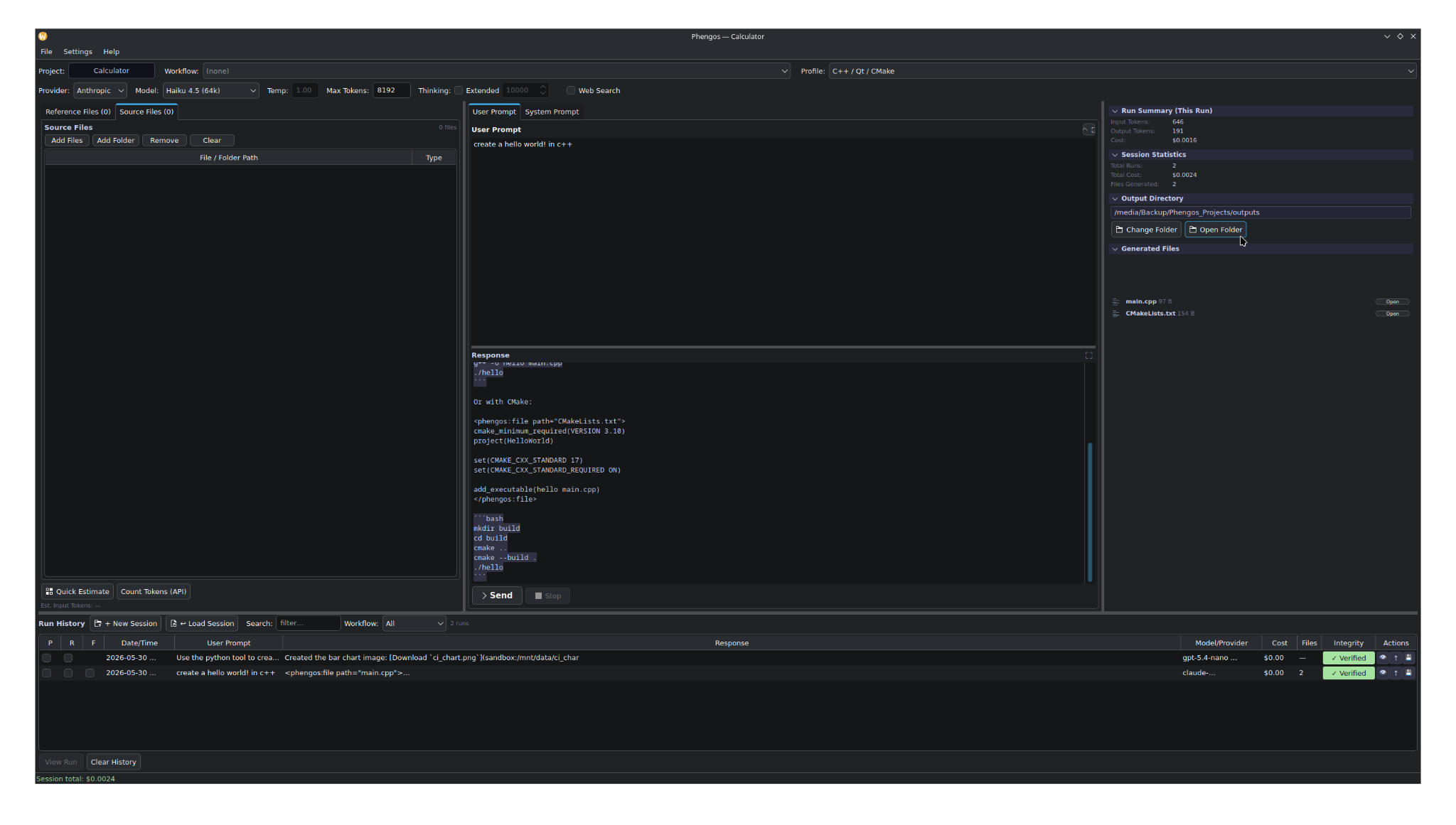
Interface
Context files, prompt composition, provider selection, and saved output are presented in a single native window.
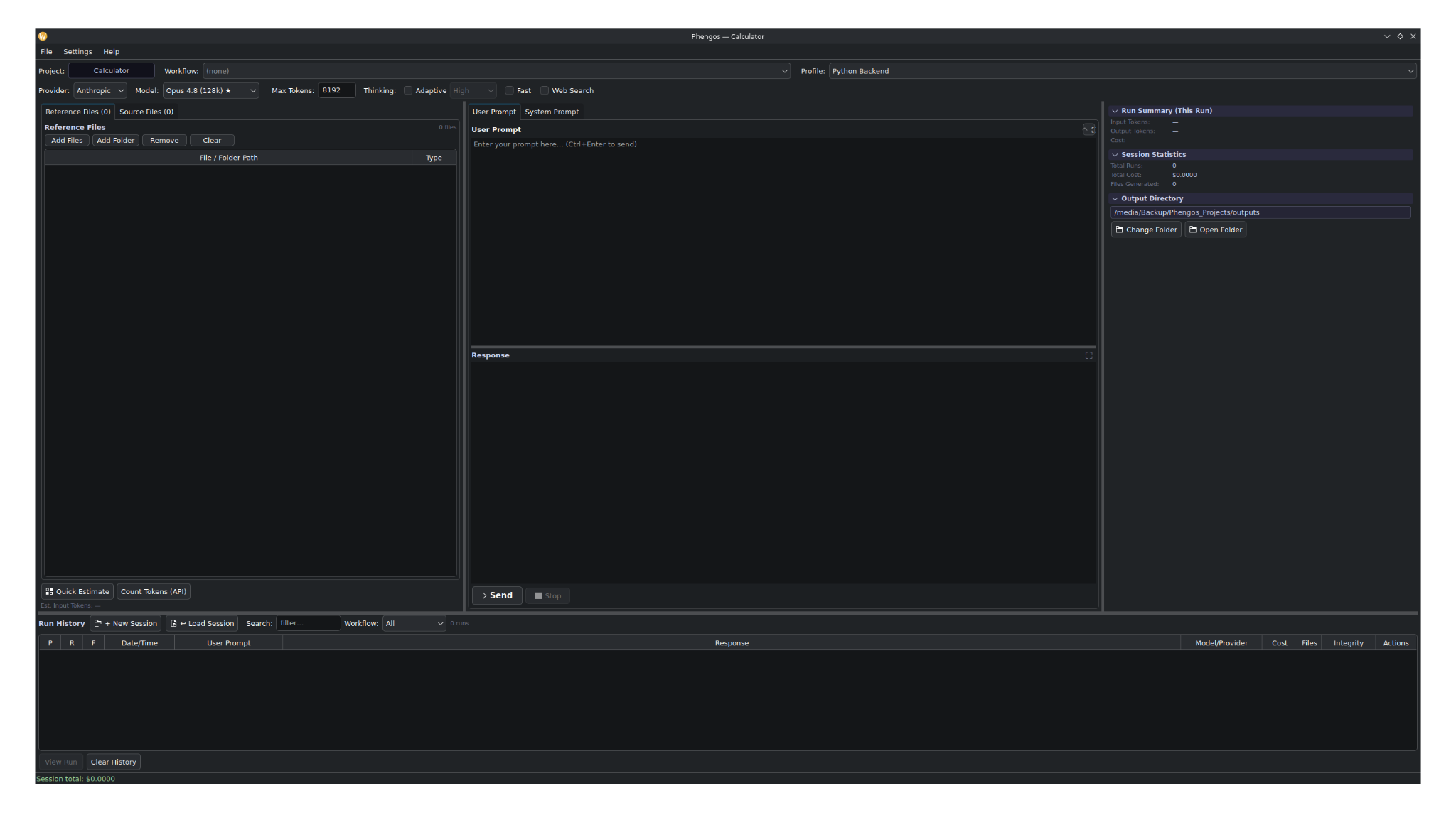
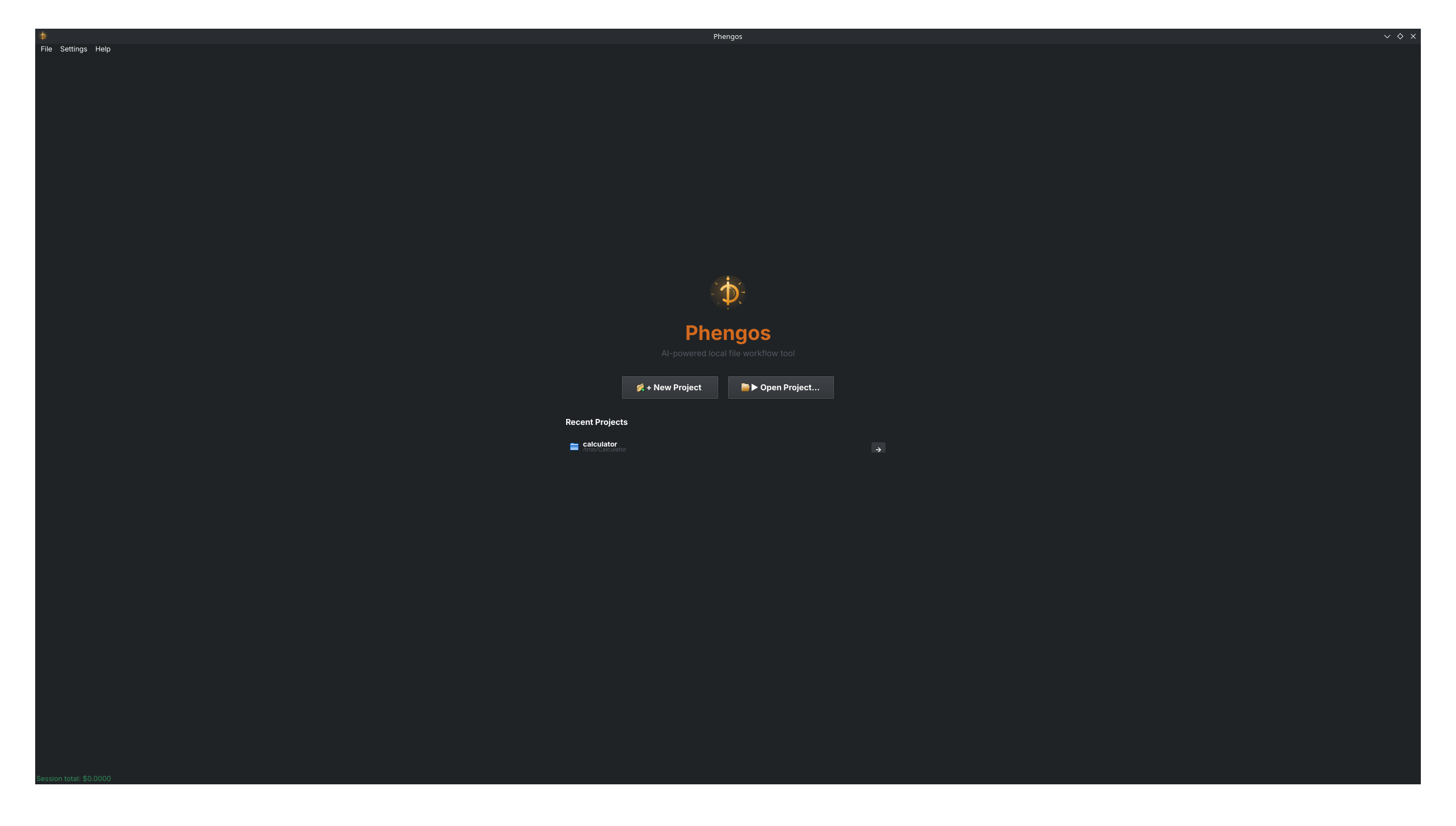
Projects and sessions
Every run is saved as a self-contained folder, organized into projects and sessions that can be reopened, searched, and reused.
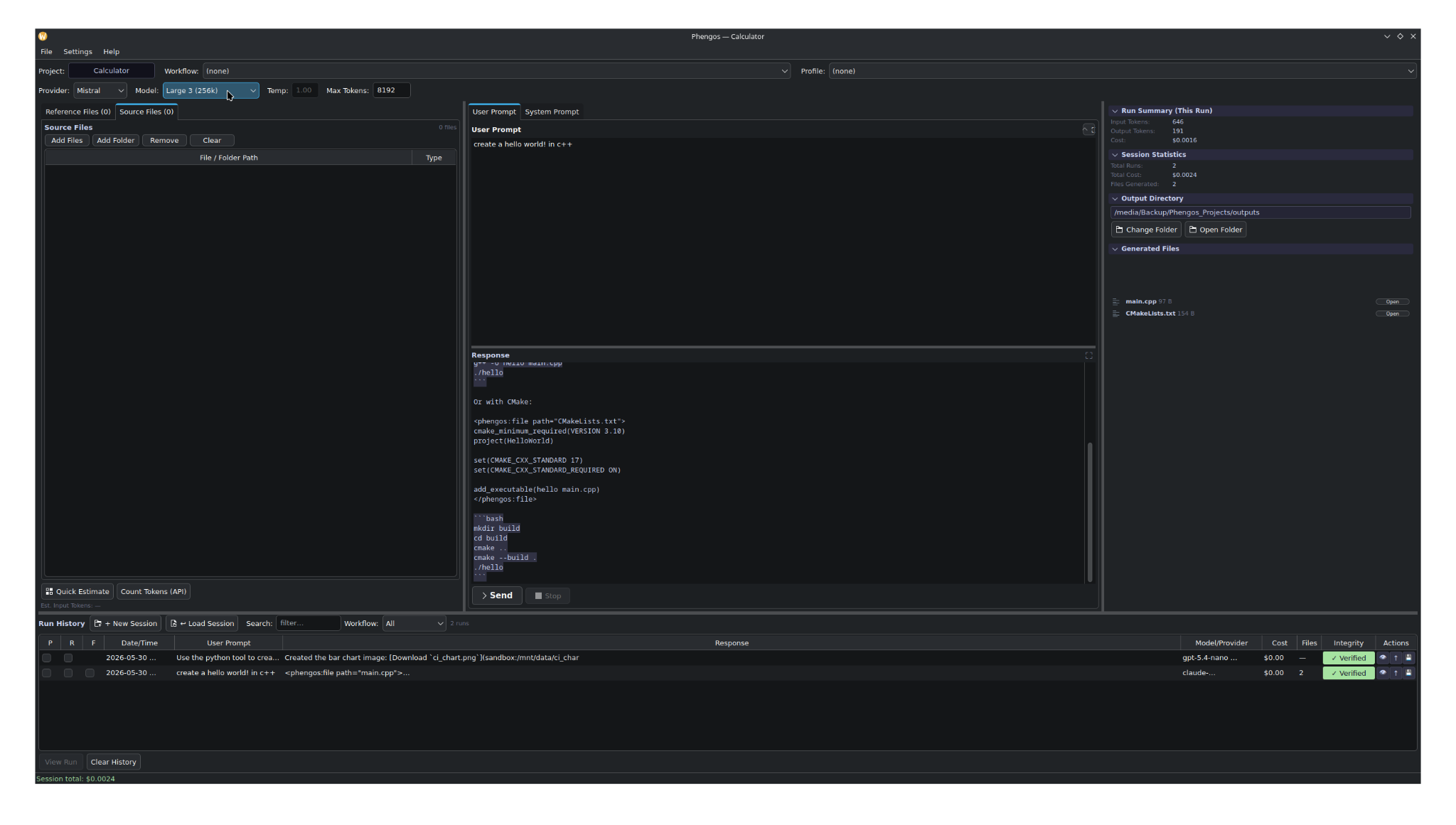
Output to project directories
Generated code and content are written directly to the project output directory and tracked against the run that produced them.
Dependency profile
Phengos is written in native C++ on the Hyperoche Engine, our in-house film-grade real-time rendering engine. That engine is the only framework it bundles; everything else relies on the libraries your operating system already maintains.
- No Electron, no embedded browser, no Node runtime.
- Nothing is downloaded and run at launch — no
curl | sh bootstrap, no plugin downloads, no auto-updating script engine. What you installed is what runs. - The riskiest pieces stay with your OS. TLS and system crypto are patched by your distro or Windows Update — immediately, with no Phengos release required.
- No bundled dependency tree. Phengos does not carry the update churn or supply-chain surface associated with bundled package stacks.
One requirement
Because Phengos deliberately leans on your operating system for TLS and the most security-sensitive libraries, keep your system updated as any flaw is then fixed the moment your OS ships the patch. See the Security Model.
Reusable workflows and profiles
Standing instructions are separated into two reusable, composable definitions rather than repeated in each prompt:
- Workflow — who the model is and what it's doing. For example, "a senior C++ engineer debugging this codebase," along with recommended settings for that kind of work.
- Profile — what it's working on and the conventions to follow. For example, "C++ headers and source,"
The two are combined per project, so one workflow can target different profiles without modification. Both are optional. See Workflows & Profiles.
Editions at a glance
| Community | Pro | Enterprise |
|---|
| Price | Free | $49 (intro; reg. $79) | Custom |
| Native C++, local-first, BYOK | ✓ | ✓ | ✓ |
| Ollama (local, offline, no key) | ✓ | ✓ | ✓ |
| Every online provider — Anthropic, OpenAI, Mistral, OpenRouter, DeepSeek, Zhipu (GLM), Qwen, Moonshot (Kimi) | ✓ | ✓ | ✓ |
| Reference / source files per run | 5 / 5 | Unlimited | Unlimited |
| Persistent history & sessions | — | ✓ | ✓ |
| Integrity verification (cloud & local) | — | ✓ | ✓ |
| Multi-turn chat (all online providers) | — | ✓ | ✓ |
| Editable provider endpoints | — | — | ✓ |
| License | Free for Commercial Use | Perpetual | Custom |
One license. Every supported platform. Your keys — or no key at all. Your data. Pro is a one-time perpetual license — you own this version forever, with no subscription and no per-device charge.
Same app, every supported platform
Phengos runs natively on Linux and Windows, and one perpetual license covers both. Additional platforms can be added where there is demand — contact sales@hyperoche.com to discuss requirements.
Download Community free · Buy Pro on itch.io · Compare editions
The Community edition is permanently free and provides the complete Phengos workspace rather than a limited trial. Bring your own key for any supported provider, or run local models through Ollama fully offline at no cost, with unlimited generations. Provider access is identical across all three editions. Your keys stay in your OS keyring and your work stays on your machine, exactly like Pro. The only limits are practical: up to five reference and five source files per run, with persistent history, sessions, and integrity verification reserved for Pro.
When you need integrity verification across both cloud and local runs, persistent reproducible history, and multi-turn chat, Pro is $49 as an introductory price — a one-time perpetual license (regular price $79).
Enterprise covers editable provider endpoints, negotiated support, and custom terms. See the editions page for details.
Text and code output
Phengos saves model output as text and code files. It targets text-based work — prose, code, and structured data as text — and does not produce binary office formats such as .xlsx or .docx.
Anthropic, OpenAI, Mistral, OpenRouter, Ollama, Zhipu AI, Moonshot, DeepSeek, and Qwen are trademarks of their respective owners. Phengos is an independent client and is not affiliated with, endorsed, or sponsored by any of them.